Electrical Engineering Capsule download Pdf | Pustak Reader

Electrical Engineering Capsule
Youth Competition Times • The Final Booster
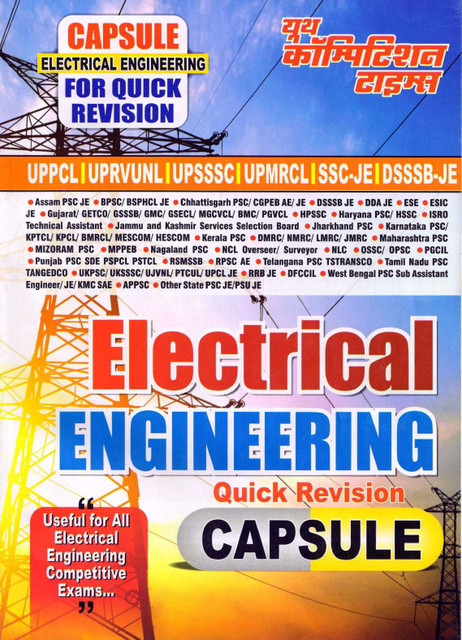
Are you overwhelmed by the sheer size of your Electrical Engineering syllabus? With exams like SSC JE, UPPCL, RRB JE, and PGCIL becoming increasingly competitive, the difference between selection and rejection often comes down to one thing: Effective Revision.
Welcome to the comprehensive review and download page for the Youth Competition Times (YCT) Electrical Engineering Capsule. This isn't just a book; it is a strategic tool designed to help you memorize, retain, and recall vast amounts of technical data in record time.
1. The "Last Mile" Problem in Engineering Exams
Every serious aspirant faces the same dilemma. You spend six months studying thick textbooks (like J.B. Gupta or Theraja) and solving thousands of MCQs from YCT Volume 1 and Volume 2. Your concepts are clear, and your numerical solving ability is sharp.
"What was the fusing factor of a rewireable fuse?"
"What is the maximum span allowed for a wooden pole?"
"What is the diversity factor usually greater than?"
These are factual questions. No amount of conceptual understanding can help you if you don't remember the specific value. This is where the YCT Electrical Capsule steps in. It bridges the gap between your detailed study and the final exam paper.
2. What makes the YCT Capsule Unique?
Unlike the massive Volume 1 and 2, which are strictly "Question Banks" containing previous year papers, the Capsule is a "Knowledge Bank." It does not contain thousands of repeated questions. Instead, it extracts the essence of those questions.
- Condensed Theory: It summarizes 500 pages of theory into 50 pages of crisp notes.
- One-Liner Format: The content is presented in a bullet-point format, mimicking the exact language used in exam questions.
- Bilingual Approach: Like all Youth Publication books, complex terms are often clarified in both Hindi and English, ensuring no language barrier hinders your revision.
- Error-Free Data: YCT is known for updating their data frequently. The capsule contains the latest IE Rules (Indian Electricity Rules) and amendments which are hot topics in recent exams.
3. Detailed Syllabus Breakdown
The Capsule covers the entire spectrum of Electrical Engineering. Here is what you will find inside:
A. Power Systems (The Backbone)
This is usually the most data-heavy subject. The capsule provides tables for:
- Transmission Line Constants: A, B, C, D parameters for Short, Medium, and Long lines.
- Insulator Strings: Efficiency formulas and safety factors.
- Cables: Grading of cables and dielectric stress formulas.
- Switchgear: Rupturing capacity, making current vs. breaking current relations.
B. Electrical Machines
Machines require a mix of formulas and logical conditions. The capsule focuses on:
- Transformers: Losses, efficiency conditions (maximum efficiency), and parallel operation conditions.
- DC Machines: Speed control methods (Ward Leonard, Field control) and their torque-power characteristics.
- Induction Motors: Slip calculations, torque-slip characteristics, and starting methods (Star-Delta, Auto-transformer).
C. Electronics (The Rank Decider)
Most electrical students are weak in electronics. The capsule simplifies this by providing direct values for:
- Semiconductors: Band gaps of Ge, Si, and GaAs.
- Rectifiers: Efficiency and Ripple factors for Half-wave, Full-wave, and Bridge rectifiers.
- Op-Amps: Characteristics of ideal vs. practical Op-Amps (Input impedance, CMRR).
D. Utilization & Estimation
This is the most volatile subject—easy to forget. The book lists:
- Illumination: Laws of illumination, utilization factors, and lamp efficiencies (Lumens/Watt).
- Heating & Welding: Types of welding and electrodes used.
- Earthing: Pipe and Plate earthing dimensions and salt/charcoal layers.
4. Strategic Use: The "15-Day Revision Rule"
To get the maximum benefit from this PDF or hardcopy, we recommend the 15-Day Rule. Do not touch this book until you have finished your main syllabus.
Step 2 (Days 11-13): Highlight the values you keep forgetting (e.g., specific resistivity values or dielectric constants).
Step 3 (Days 14-15): Only read the highlighted portions. This ensures that the most volatile data is fresh in your short-term memory when you walk into the exam hall.
5. Why Digital PDF vs. Hardcopy?
We are providing the link to the PDF format for accessibility, but we strongly advise serious aspirants to buy the hardcopy. Here is why:
The Capsule is a book meant to be scribbled on. You should be adding your own short notes into the margins. When you make a mistake in a mock test, write that mistake into your Capsule. Over time, this book becomes your personalized "Bible of Mistakes," making it the single most valuable asset you own.
6. Frequently Asked Questions (FAQ)
Q: Is this book sufficient for GATE?
A: No. GATE requires deep conceptual problem solving. This Capsule is designed for JE (Junior Engineer) and AE (Assistant Engineer) exams like SSC, RRB, and State PSUs where factual questions dominate.
Q: Does it cover General Awareness or Reasoning?
A: No, this is a purely technical handbook dedicated to Electrical Engineering core subjects.
Q: Is the content in Hindi or English?
A: The terms and technical words are in English, but explanations often use a "Hinglish" (Hindi-English mix) style to make it easier for Indian students to grasp quickly.
7. Final Verdict
The Youth Competition Times Electrical Engineering Capsule is not a replacement for hard work; it is an optimizer for it. It ensures that the hard work you did in learning concepts doesn't go to waste because of a forgotten formula.
If you are serious about cracking the upcoming vacancy in 2024-25, download the PDF, print it out, or order the book today. Your future self, sitting in the exam hall, will thank you.
Disclaimer: We do not own the copyrights to this material. This post is for educational and informational purposes only. We encourage students to support the publishers by purchasing original copies.


